Do you know anyone in your circle who is genuinely passionate about energy? Until a few months ago, most people would probably have answered ‘no, I don’t’. Back then, energy was a niche interest reserved for a small band of technical enthusiasts, committed environmentalists and politicians hunting for a cause.
Today, energy is on everybody’s lips. Shortages and the tension they create can bring down governments, trigger acute financial crises, reshape the political landscape and even put military units on combat alert.
It took only two years of pandemic, runaway money printing, two years of ignoring the rules and sound practice of public finance, the push of extreme environmental ideas and less than a year of the Russian-Ukrainian war to make people grasp that one of the most vital means of survival is having energy.
The current energy panic has literally everyone discussing energy. Ordinary households are scrambling to set up their own alternative sources (wood, solar panels). The well-off are shutting up their cold homes and heading off for a couple of months to warmer countries. Governments are trying to stockpile large energy reserves, well aware that a shortage would be a mortal threat to the national economy and to the powers that be.
Yet this feverish hunt for the energy we need is narrow in scope. Everyone is focused on where to buy, divert or negotiate supplies. Almost nobody is planning to pull it out of the earth’s depths or its surface.
This article is about the people who, almost a century ago, used bold vision, hard labour and cutting-edge technology to create a great energy source that transformed the American Southwest and, a dozen years later, the face of the global economy.

A Brown, Brutal Planet
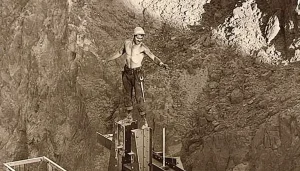
To exhausted travellers the scene looked like a textbook mirage. But it was no illusion — it was the real Nevada desert. Near the Black Canyon of the Colorado River (Nevada/Arizona), in the middle of a hellish wasteland, hundreds of people were camped out in temperatures above 45°C. Everything around them was scorched by the roasting sun, colourless or tinted with hundreds of shades of dead red and brown. Whole families eked out an existence here in old cars, shacks or tents.
The spot they chose for their wandering life was called Hemingway Wash, right beside the towering rock of Cape Horn. It was one of the last relatively flat stretches of riverbank on the Nevada side, before the brisk current plunged into the steep, dark Black Canyon, walled in by massive rock faces tens of metres high. Living on the banks of this inhospitable river, in oven-like heat, might have seemed the height of misery. That it could be worse was clear only from the nearby hills flanking the canyon. This was no environment for human beings. As far as the eye could see, there was no living vegetation. Nature was so harsh that it recalled the images humanity would come to know decades later from satellites sent back from the surface of the red planet, Mars.
These people came to share the riverbank with venomous spiders, clusters of arthropods and desert snakes. One might have expected the Colorado River to offer some relief in this strange place. Yet it gave not the slightest comfort, thanks to the masses of sediment carried in its swift currents. The water “was too thick to pump … and too thin to shovel with shovels”. The nomadic residents, even with water within reach, had to either wait until the next day for the natural impurities to settle or repeatedly strain it through makeshift filters after drawing it. This macabre gathering of exhausted people, forming an unreal Ragtown, was as real a picture as any of the USA in the early 1930s.

A Vivid Portrait of the Depression
These people came to the Nevada desert of their own accord. The nomads were a living illustration of the American economic depression that struck in 1929. That unprecedented collapse of the US economy threw thousands out of their family homes and drove them to places where there was — even a minimal — chance of work, even if those chances were utterly unfit for human existence. Black Canyon was one such place.
As one US senator put it, most of the Wild West should not be settled by US citizens unless it served as forced exile for a committed crime. Across much of the Western Territory, one of the few chances of survival was to settle near a railway and secure access to drinking water. Without that, being in the desert was a game of roulette with your life. This desert gamble had its own name: “40 miles” (about 60 km), the distance animals — even the hardiest, such as American mules — and their handlers can travel without water.
Whichever way the newcomers looked, no rescue was in sight. East of Ragtown, the Black Canyon area was dominated by bleak rocks running along a hostile river; north and south stretched a boundless desert. It could be crossed for days without meeting a living soul. After many hours of travel, at best you might reach one, perhaps two, human-trodden trails. West of Black Canyon, the only trace of civilisation was a tiny, dusty town surviving on the railway line, a few brothels and a couple of bars. This boarded-up hellhole was well on its way to joining the long list of Wild West ghost towns.
Las Vegas, “the Fertile Plain”
By the end of the 19th century, more than 90 per cent of the West’s mining towns were ghost towns, bearing the most beautiful names people could dream up at the time: Gold Acre, Silverhorn, Star City, Diamond Field, Queen City, Monte Cristo, Lucky Boy or Eldorado. The town near Black Canyon also had a fancy name, but it sounded like a bad joke. Who could take seriously a place called the “Fertile Plain”, or more precisely — because of its Mexican roots — Las Vegas? Anyone who had been there could firmly confirm it was the dustiest and driest place on the planet. Nature had spared it almost everything. Settlers avoided Las Vegas and southern Nevada in as wide an arc as possible. Everyone wanted to reach California and Oregon. That was until word spread that this unfriendly land hid not only what everyone coveted — gold and silver — but also what was essential for survival: water!
In September 1930, people who had been wandering the desert for weeks and months caught a glimmer of hope. An event took place that could mark the start of a new life for them. Both the poor of the makeshift camps and the social and political elite of Nevada and the neighbouring Southwestern states gathered in the Mojave Desert. The latter arrived by chartered trains, buses and a few planes. Millions of Americans huddled around radio sets, looking for a personal spark of hope in coverage of the event that confirmed the raging depression was about to end. Millions were waiting for good news, and among them, in August 1930, nearly four million unemployed. This army of the poor grew exponentially, reaching the unprecedented figure of nine million jobless by 1933. This was no longer an economic crisis; it was a real catastrophe.
A Change of Location
On 7 September 1930, about 10 km south of Vegas, Ray Vilbur (President Herbert Hoover’s envoy) finally drove a golden nail (smelted silver, for the record) into the first sleeper of the new railway line after a couple of failed attempts. It was meant to link the area next to Black Canyon with the only visible point of civilisation on the horizon — Las Vegas, a few dozen kilometres away. Construction began on the eighth wonder of the world: a 224-metre-high dam and hydroelectric plant on the Colorado River — a wonder that would go down in history as Boulder Dam, as locals call it, or Hoover Dam, as tourists and politicians call it.

The new wonder of the world was originally to rise in Boulder Canyon, more than 120 km from Las Vegas. The whole construction site was to be built near that spot too, but — as has happened many times before and since — an unlikely stroke of luck came to this small, dusty town. Despite decades of geological research and years of planning, the final location was settled only a few years before Congress decided to start construction. And that location was not Boulder Canyon. The site was moved south, just beyond the edges of Las Vegas. Geologists concluded that the original Boulder Canyon location was not the best, for geological reasons and for pure economics. Black Canyon sat at a lower elevation than the originally chosen site, saving time and money. The terrain along the Black Canyon rim also proved more favourable. There was no need to carve platforms into the rock for the machinery and buildings of the future site. Nor was it necessary to excavate the dam’s foundations as deeply as planned at the first location. By moving the dam closer to Las Vegas, the reservoir meant to store and regulate the river’s water level could be much larger. The existing rail line through Vegas made it easier to haul materials and house thousands of future dam builders.
Credit: Ted-Ed
Is California Out to Steal Their Water?
Not only did the planned dam’s location change. Views on why it should be built were revised too. It was originally meant to shield California’s fertile Imperial Valley from the river’s devastating floods. California’s farming areas, already booming economic centres in the 1920s, were to stop fearing the violent floods of the unpredictable Colorado. Many times before, the river had washed away farms, plantations and painstakingly built irrigation canals. As 90 years ago, California today is a state where agriculture is the number one economic sector and consumes up to 80% of local water resources. 90% of all water available in the West is used to irrigate desert land. The interests of individual states have clashed with those of powerful California.

The smaller states began to stress their own needs and the fact that the Colorado is ‘their’ river. Its main source is the Rocky Mountains and their melting snow. With a total length of more than 2,300 km, the river runs through Colorado, Wyoming, New Mexico and Utah. The Colorado drains into a delta on Mexican territory and eventually ends in the Gulf of California. It flows mainly through the territory of another great state, Arizona, which has fiercely battled its big neighbour, the Republic of California, ever since becoming a US state.
California’s insatiable thirst for water became a source of conflict that would last for decades after the dam was built. Each state tried to prove it had been wronged in the allocation of water at its disposal. All of them also claimed, unanimously, that California wanted to steal their water. Fierce debates ran from 1928 for decades afterwards. It was not until 1963 that the US Supreme Court ruled to cut the amount of water released to California and give some of it to its neighbours — primarily Arizona. The dispute did not end in 1963 or 1968; in fact it continued until 2007, when an agreement to distribute Colorado River water was signed anew.